The Hidden Price Tag on Watching Everyone Else Build Their Thing
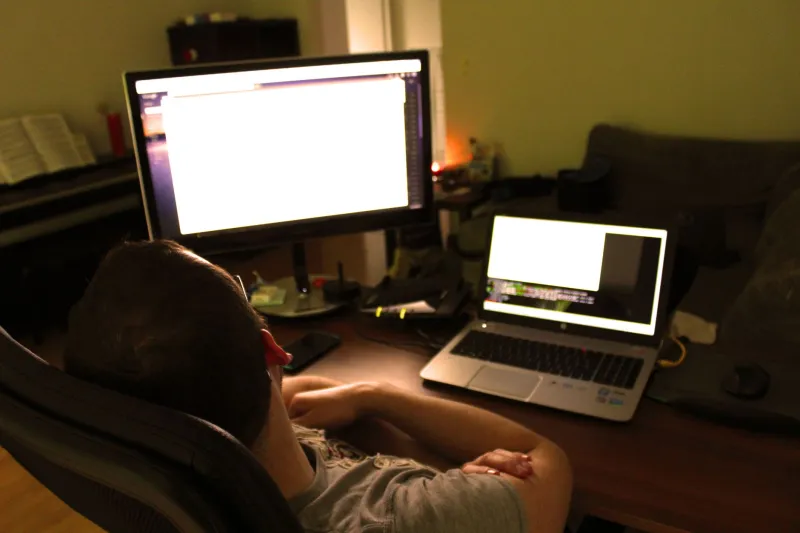
There's this habit a lot of creatives fall into that nobody really talks about as a problem. You tell yourself it's research. You call it staying competitive. You frame it as knowing your market. And sure, some version of that is genuinely useful. But somewhere between "awareness" and "obsession," a line gets crossed — and most of us cross it without noticing.
I'm talking about the constant, low-grade surveillance of what other people in your space are doing. The newsletter you signed up for because a competitor writes it. The Instagram account you check every morning even though it reliably makes you feel behind. The LinkedIn posts you dissect like they're ancient scripture. The rabbit holes that start with one person's announcement and end forty-five minutes later with you staring at someone's client list wondering where you went wrong.
That habit has a price. A real one. And it's worth actually adding it up.
The Hours Are the Easy Part to Count
Let's start with the most concrete cost: time. If you spend even thirty minutes a day checking in on what peers, competitors, or adjacent creatives are up to — and for a lot of people it's more than that — you're burning roughly three and a half hours a week. That's over 180 hours a year. More than four full work weeks, gone.
Now ask yourself: what did you actually produce from that time? Did it change your strategy? Did it give you an idea you wouldn't have had otherwise? Or did it mostly just make you feel vaguely unsettled and generate a to-do list of things you feel like you should be doing?
For most people, the honest answer is closer to the second option. The watching isn't really intelligence gathering. It's anxiety dressed up as diligence.
The Idea Erosion Nobody Talks About
Here's the subtler cost, and in some ways the more damaging one: constant benchmarking quietly erodes the originality of your own thinking.
When you spend a lot of time immersed in what other people are building, your brain starts treating their choices as the default template. Their service offerings start to feel like the standard. Their aesthetic becomes the reference point. Their positioning shapes your sense of what's possible or acceptable in your space.
And before long, you're not building your thing — you're building a slightly modified version of theirs.
This isn't a character flaw. It's just how brains work. We're pattern-matching machines, and we build from the inputs we're given. If your primary creative inputs are other people's finished products, your outputs are going to reflect that. The ideas that feel most "safe" or "smart" will be the ones that already exist in some form.
The work that actually cuts through — the stuff that makes people stop scrolling and pay attention — almost always comes from somewhere less crowded. It comes from your actual experience, your weird specific obsessions, the things you've lived through that nobody else has in quite the same way.
You can't access that material when you're busy cataloging everyone else's.
Competitive Awareness vs. Competitive Anxiety
Here's where I want to be careful not to overcorrect. Knowing your industry matters. Understanding what's already been done, what's working, what the conversation in your space looks like — that's legitimate and useful information. Pretending otherwise is its own kind of creative vanity.
But there's a real difference between competitive awareness and competitive anxiety, and the distinction is mostly about frequency and intention.
Competitive awareness looks like: doing a quarterly check-in on what's happening in your space, taking notes, drawing actual conclusions that inform your decisions, then moving on.
Competitive anxiety looks like: a daily (or more) compulsion to monitor what others are doing, driven not by strategy but by fear — fear of falling behind, of missing something, of being irrelevant.
One of those is a tool. The other is a trap.
A Framework That Actually Works
If you want to stay informed without letting that information become a cage, try building some structure around it.
Schedule your industry check-ins. Treat competitive research like a meeting with a fixed time slot — once a month, maybe once a quarter. Outside of that window, you're not doing it. This sounds rigid, but it works because it removes the low-level permission you've been giving yourself to check in anytime anxiety spikes.
Ask what you're actually looking for. Before you open someone's website or scroll their feed, name the specific question you're trying to answer. "Am I checking prices?" "Am I looking at how they structure their offers?" "Am I just feeling insecure right now?" That last one is important to catch. If you can't name a real strategic question, close the tab.
Audit your inputs. Go through the newsletters, accounts, and feeds you consume regularly and ask whether each one is actually making you better at your work — or whether it's just generating noise and comparison. Unsubscribe ruthlessly. Your creative brain will thank you.
Replace watching with making. This one sounds obvious, but it's powerful in practice. Every time you feel the pull to check what someone else is building, redirect it into ten minutes of working on your own thing. Over time, that redirection trains your nervous system to associate the creative urge with output rather than consumption.
The Thing You're Actually Protecting
Underneath all of this is something worth naming directly: your perspective is a finite resource, and it gets diluted every time you flood it with someone else's.
The reason people hire you, follow you, buy from you, or want to collaborate with you is because of something specific to how you see things. That specificity is your actual competitive advantage — not your awareness of what competitors are charging or what their latest project looks like.
You protect that specificity by being selective about what you let in. By spending more time in your own head than in everyone else's feeds. By trusting that what you're building has value even when you can't immediately benchmark it against something else.
The comparison tax is real. You're paying it in time, in original ideas, and in the slow erosion of the confidence it takes to make genuinely interesting work. The good news is it's also completely optional.
Stop watching so much. Start building more. That's the whole framework, really.