What AI Can't Fake: Why Mastering Real Craft Is Your Smartest Move Right Now
Let's skip past the panic. You've already heard the takes — AI is going to replace designers, writers, illustrators, musicians, all of it. Some of those takes have merit. Some are overblown. Most of them miss the more interesting question entirely.
The interesting question isn't whether AI can do what you do. The interesting question is: what can you do that AI can't convincingly replicate, and how do you lean into that so hard it becomes your entire competitive advantage?
Because there is an answer. And it's not abstract or philosophical. It's practical, learnable, and increasingly rare.
The Flood Is Real — and It's Creating a Shortage
When everyone has access to the same generation tools, the output starts to look the same. This is already happening. Scroll through AI-generated content for long enough and a kind of visual and tonal homogeneity emerges — a sameness that's technically competent and aesthetically hollow. It hits the marks without carrying any weight.
This isn't a criticism of the technology. It's just an observation about what happens when any tool becomes universally accessible: it stops being a differentiator. The work it produces becomes the baseline, not the ceiling.
What that creates — quietly, without much fanfare — is a scarcity of things made with genuine human decision-making baked into every layer. Work where the imperfections are meaningful rather than accidental. Work where you can feel the choices. Work that couldn't have come from a prompt.
That scarcity is becoming valuable faster than most people realize.
What Machines Are Actually Bad At
AI systems are extraordinary pattern recognizers. They're trained on existing work, which means they're exceptionally good at producing plausible versions of things that already exist. That's genuinely useful for a lot of tasks.
But pattern recognition has limits. Here's where those limits live:
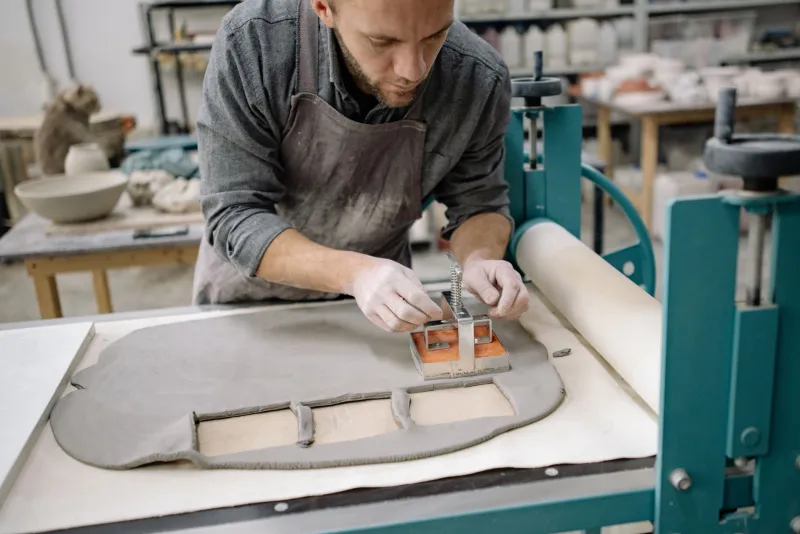
Embodied knowledge. A woodworker who's spent years feeling how grain responds to different tools carries knowledge that exists in their hands, not in their head. That knowledge can't be fully described in text, which means it can't be fully trained into a model. The same goes for a ceramicist reading a glaze, a printmaker adjusting pressure, a tailor reading how fabric moves on a specific body. This is knowledge that lives in physical experience.
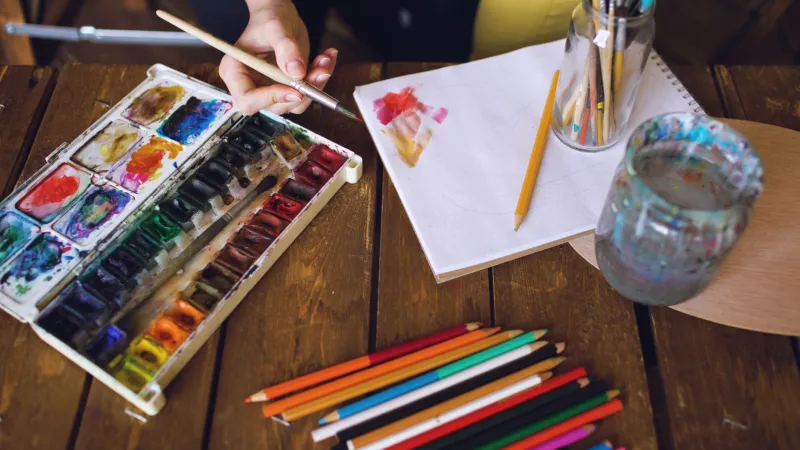
Genuine constraint. When a painter works with a limited palette not because the algorithm suggested it but because that's what they have — and something unexpected emerges from that limitation — that's a creative process that's fundamentally different from optimization. Real constraints produce real surprises. Simulated constraints produce the appearance of surprises.
Contextual meaning-making. AI can produce work that looks like it means something. It can't actually mean something, because meaning requires a maker with stakes in the outcome, a perspective shaped by specific experience, and a genuine relationship with the audience. When a human makes something autobiographical, culturally specific, or rooted in a particular community, that work carries a kind of authenticity that generated content structurally cannot replicate.
The long game of a developing practice. There's a coherence that emerges over years of serious creative work — a recognizable sensibility, an evolving set of obsessions, a body of work that shows genuine growth and contradiction and change. That's not a portfolio. It's a life's work. And it's the thing that makes a creative voice irreplaceable rather than interchangeable.
Craft as Competitive Strategy
None of this means you should ignore AI tools or treat technology as the enemy. That's not the argument here. The argument is about where to invest your development energy in a landscape that's shifting fast.
If you're spending most of your creative development time getting better at prompting generators, you're building fluency in a skill that everyone else is also building, in a tool that will keep evolving in ways you can't control, producing outputs that look increasingly similar to everyone else's outputs.
If you're spending that same time developing deep technical skill in a discipline that requires real practice — letterpress printing, hand-drawn type, analog photography, woodworking, ceramics, traditional illustration, live sound engineering, hand-sewn garments — you're building something that compounds differently. The skill becomes yours in a way that can't be replicated by someone who just discovered the same tool.
This isn't romanticism about old methods. It's a clear-eyed read on where scarcity is heading.
The Hybrid Advantage
The most interesting creative position right now isn't purely analog and it isn't purely AI-assisted. It's the person who has deep craft knowledge and can make intelligent, selective decisions about when and how to use generative tools — and when to put them down entirely.
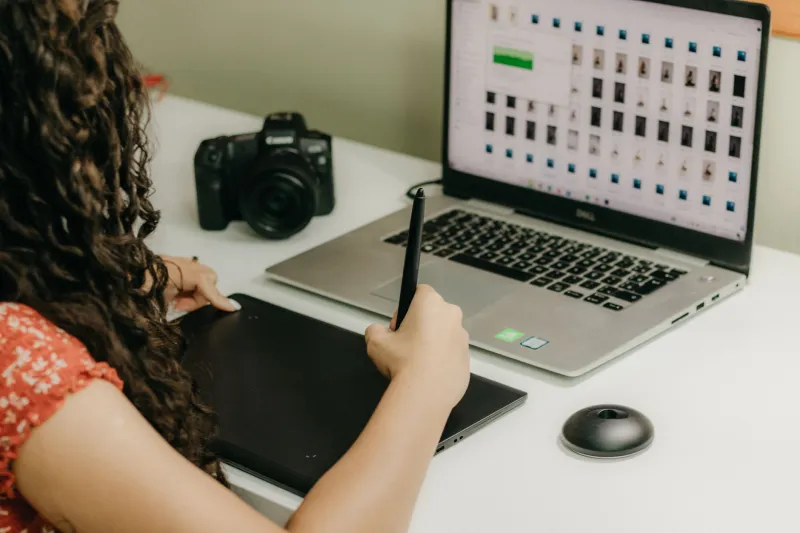
A photographer who understands light at a technical and intuitive level will always get more from AI editing tools than someone who doesn't. A writer with genuine voice and structural instincts will use language models as an accelerant rather than a crutch. A designer with real visual training will be able to evaluate, direct, and improve AI-generated work in ways that an untrained eye cannot.
Craft knowledge doesn't make you anti-technology. It makes you a more sophisticated user of every tool, including the new ones.
What to Actually Do
If you're a creative who's been on the fence about going deeper into technical skill development — learning a traditional process, taking on a discipline that requires real time investment, building fluency in something genuinely difficult — this is the argument for doing it now rather than later.
Not because it's pure or noble. Because it's strategic.
Pick one discipline that requires embodied learning — something you have to physically practice to improve at. Commit to a year of serious development in that thing. Document the process, not for content, but for your own understanding of how the skill is developing.
At the end of that year, you'll have something that's genuinely yours. Something that reflects specific choices, specific constraints, specific hard-won knowledge. Something that couldn't have been generated.
In a landscape flooded with content that technically exists but doesn't mean anything, that's not a small thing.
That's the whole game.